A plain flock almanac Launch price $57 $37 Get the book

Dry, fed, safe and busy

Your hens have been telling you what’s wrong. Nobody showed you where to look.

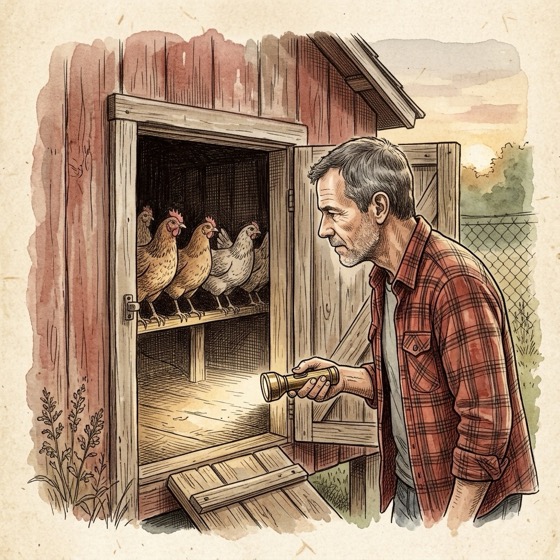
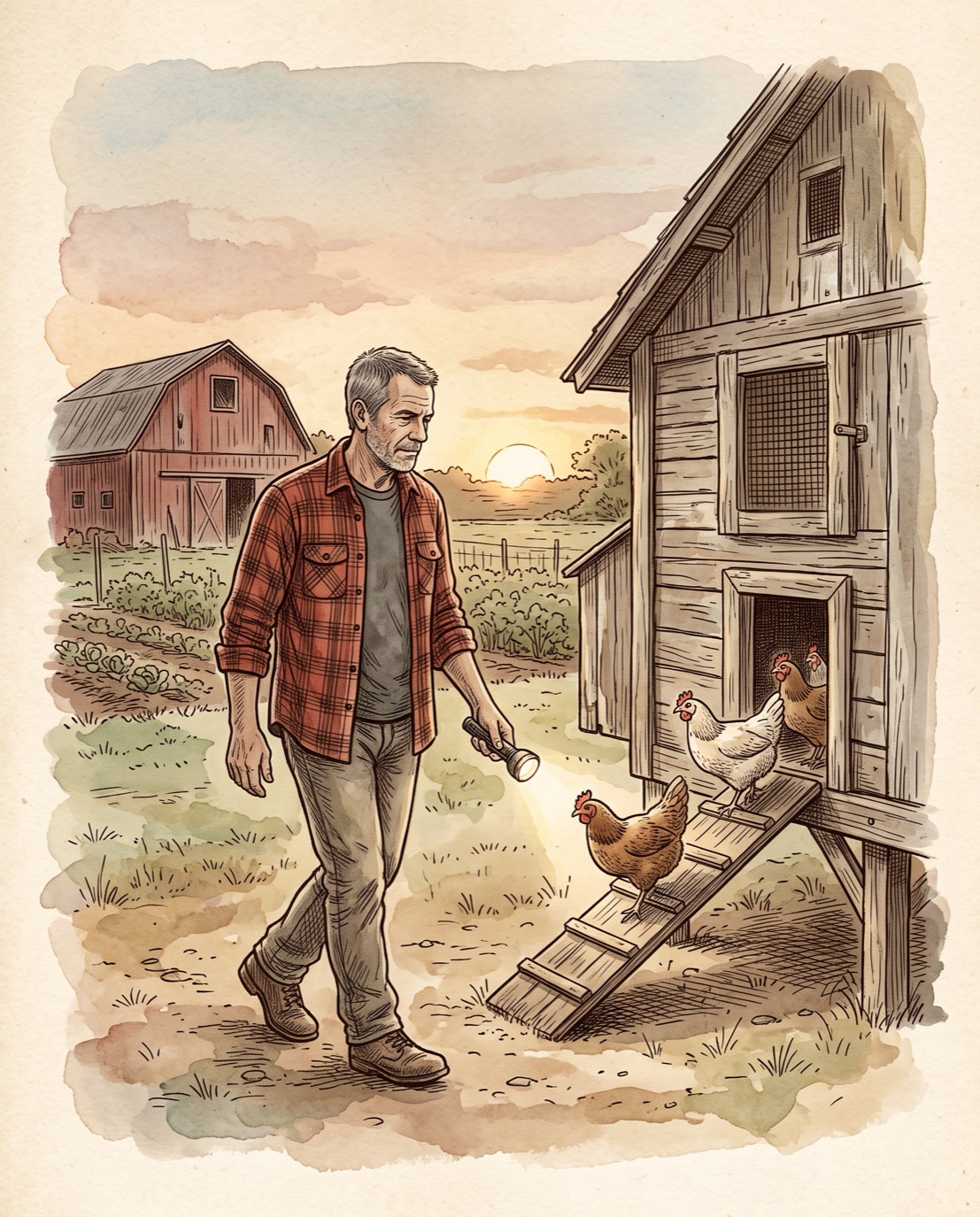
A hen hides trouble as long as she can, but she can’t hide all of it. She’s the last one off the roost. Her comb is a shade paler than it was on Sunday. The floor stings your nose at knee height. All of that is there to see a few days before you’d call it a problem, if you know the hour and the place.

This book gives you the place, the hour and the order: what to look at, what it means, what to do first, and when a thing is past you and it’s time to call somebody.

Read Chapter 1 free

Instant download. Read it on your phone, tablet or computer, or print it at home. Pay once, yours to keep.

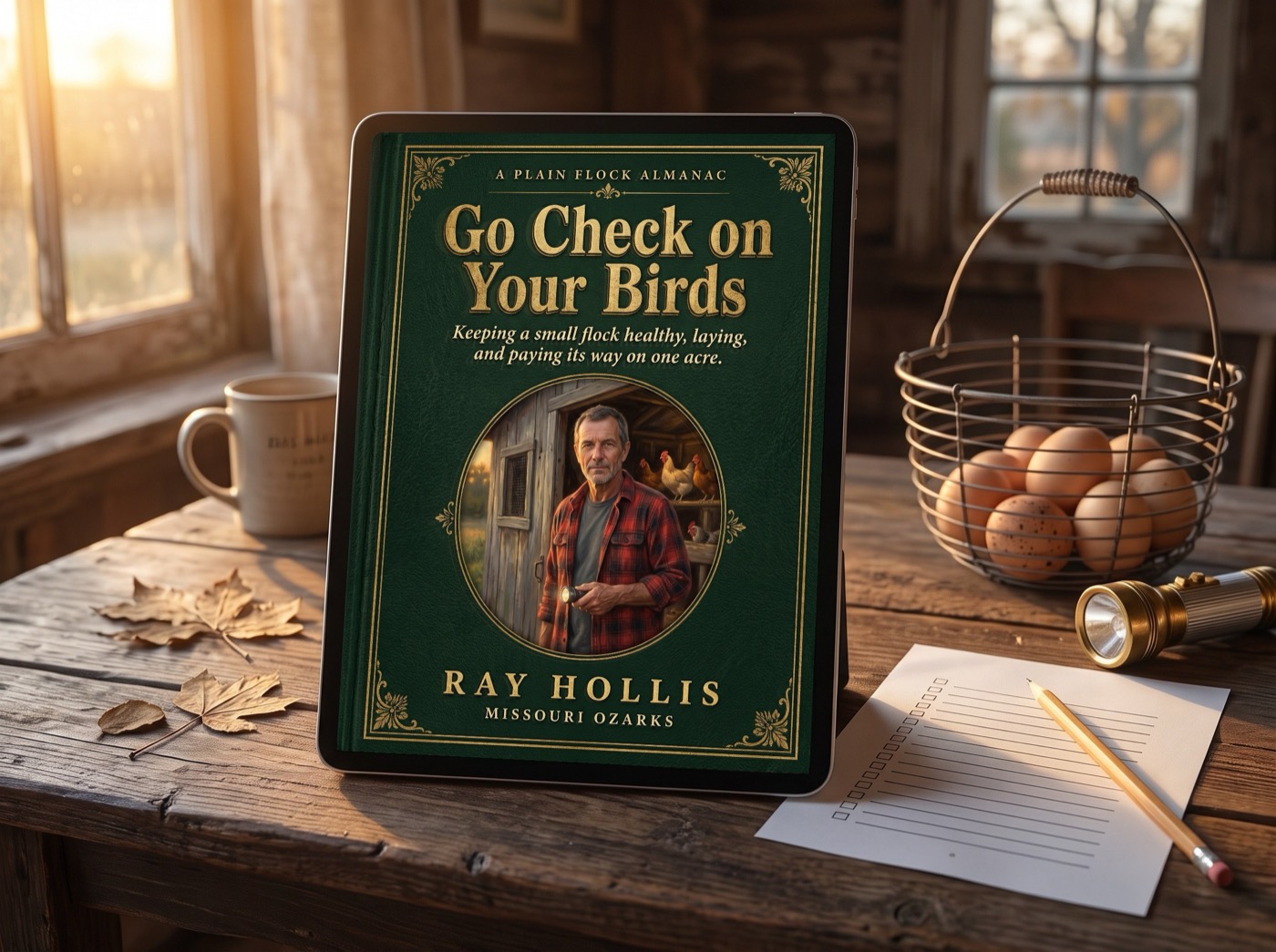
Go Check on Your Birds, by Ray Hollis

Something wrong tonight?

Find what you’re seeing. Go where it sends you.

These are eight of the 29 lines in the book’s Trouble Finder. Open it on the feed bin with a flashlight in your other hand. Every line sends you to a numbered section, and nearly every method ends with the same thing: a small check you can do tonight, before you buy anything.

What you’re seeingLook first atSection
A hen that isn’t right and you can’t say whyThe hands-on check1.4
The coop stings your noseThe smell test4.2
Birds missing or killed, door still shutReading the scene5.2
No eggs, or fewer eggsThe checking order10.2
Eggs disappearing, wet shell in the nestHow egg eating starts11.2
Something crawling on your arm at duskThe flashlight check13.3
Hen won’t leave the nest, hot and crossThe four signs15.2
Several birds dead or sick at once, purple combs, swollen headsReport it today16.8

The numbers

Your eggs aren’t free. Here’s the sum.

Plenty of people will tell you a flock pays for itself. This book writes down a twelve-hen year, line by line, and shows you where it comes out: a home flock usually doesn’t beat a plain store carton on cash.

You still might want the hens. Plenty of people do. You’ll just be keeping them with your eyes open, and you’ll know which lines to go after. Feed is two dollars out of every three, and a hen who’s laying well is worth about twice a bargain on the bag.

A dozen eggs, by how you count it
Feed alone$2.68
All cash costs$3.98
Cash, plus the coop written off over 10 years$4.48
Store, plain large whiteabout $3.50
Store, pasture-raised cartonabout $7.00

From section 19.2: twelve hens, 180 dozen eggs a year, typical 2026 U.S. prices. Store prices are the author’s estimates, not a survey. Yours will differ, and the book shows you how to run your own.

What’s inside

Twenty chapters. Each one built on a single plain claim.

Read it straight through before the chicks come, or go by the symptom when something’s wrong. Every section is numbered, so 13.5 is always the mite cycle and 4.2 is always the smell test.

Part I

The Walk

Learn to see the flock before you change anything.

The Dusk Walk
It is not sudden. Most flock trouble shows days early, to anyone looking at the right hour.
The Flock You Actually Need
It is not too little work ethic. It is too many animals.

Part II

The Place

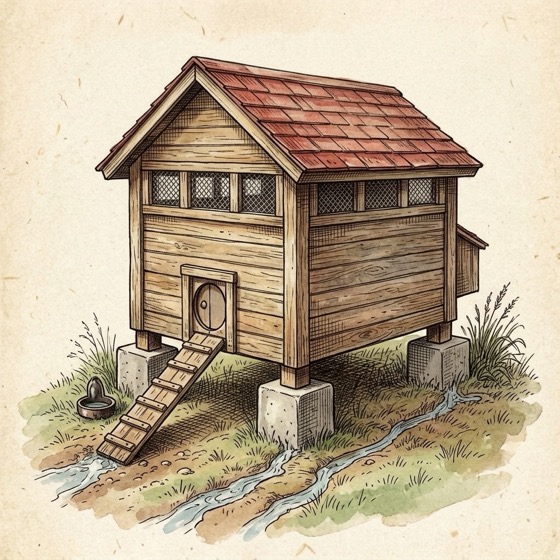
Most bird problems start as building problems.

The Dry Box
It is not the price of the coop. It is where the water goes.
The Litter You Don’t Shovel
It is not a dirty coop. It is a wet one.
Everything Eats Chicken
It is not bad luck. Each predator leaves its own signature and has its own fix.
The Run That Keeps Them Busy
It is not mean birds. A hen with nothing to scratch will scratch at her sister.

Part III

Water and Feed

Where most of the money goes.

Water First
It is not the feed. Laying often stops at the waterer first.
The Bag and the Math
It is not the price per bag. It is the price per egg.
Feed Off the Acre
Free feed does not replace the bag. It makes the bag last longer.

Part IV

Eggs

The reason most people started.

Why They Stopped Laying
It is not one thing, but there is an order to check.
The Nest Box
It is not a wicked hen. It is a bright box, a shallow box, or a thin shell.
Nest to Table
The old ways of keeping eggs work best when you know their limits.

Part V

Trouble

What the walk finds, and what to do next.

Mites, Lice, and Worms
It is not a dirty coop. It is a cracked one.
The Pecking Order
It is not a mean flock. It is usually crowding, boredom, or a bad introduction.
Broody Hens and Chicks
It is not sickness. It is a hormone, and sometimes it’s the cheapest incubator you’ll ever own.
The Sick Bird
The job is not to be the vet. It is to see it, separate her, and know who to call.

Part VI

The Year

How the flock becomes a system.

Winter and Summer
It is not the cold. It is damp air and a heat lamp.
The Old Hen and the Extra Rooster
Every flock reaches this decision. Make it ahead of time.
The Flock Ledger
It is not whether chickens pay. It is whether you wrote it down.
The Flock Year
The old keepers weren’t working harder. They knew what the month called for.

And at the back: buy-first lists at $50, $150, $500 and $1,500; reference tables for feed, water, space, eggs and costs; two coop plans with cut lists, for 4 hens and 12; and the sources, a glossary and an index.

A look inside

Real pages from the book.

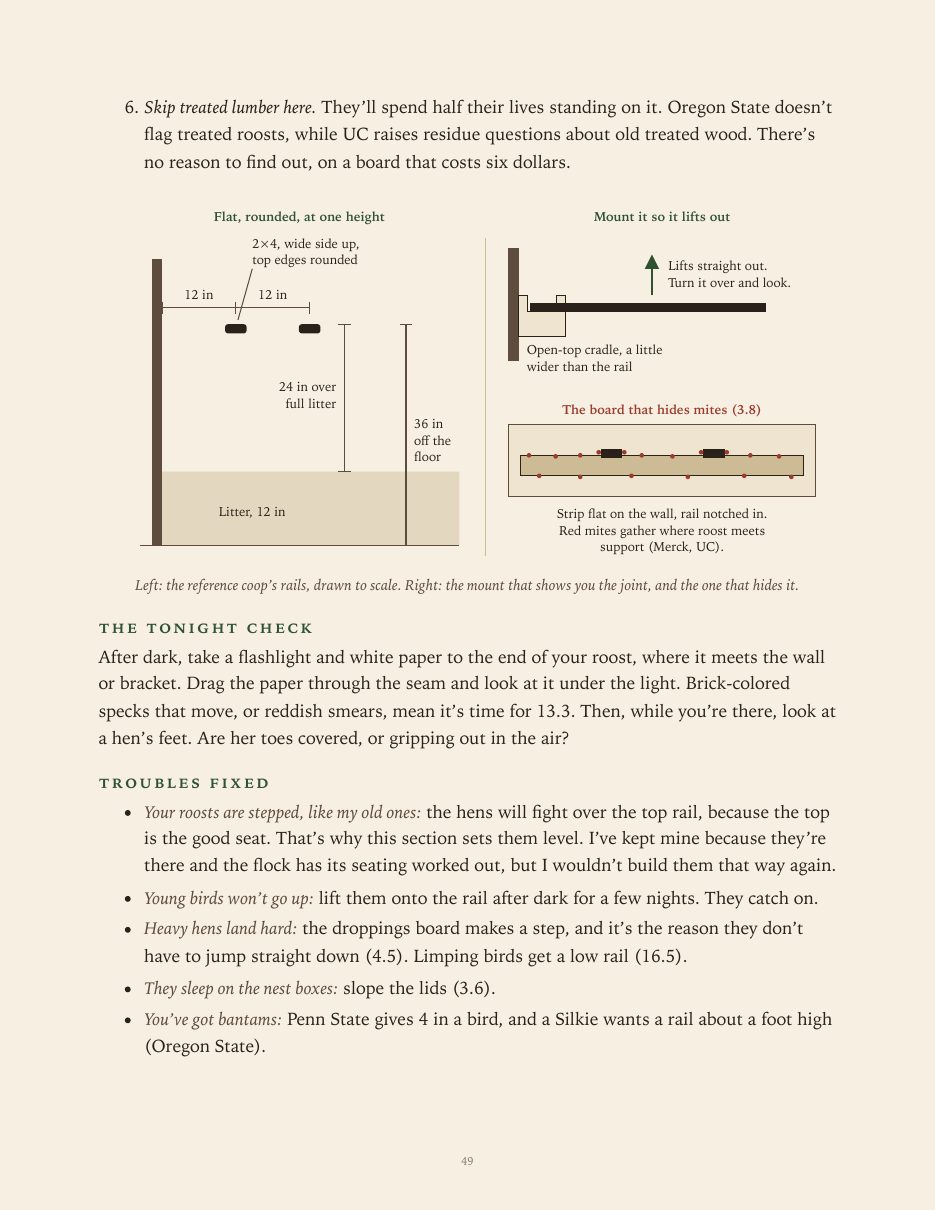
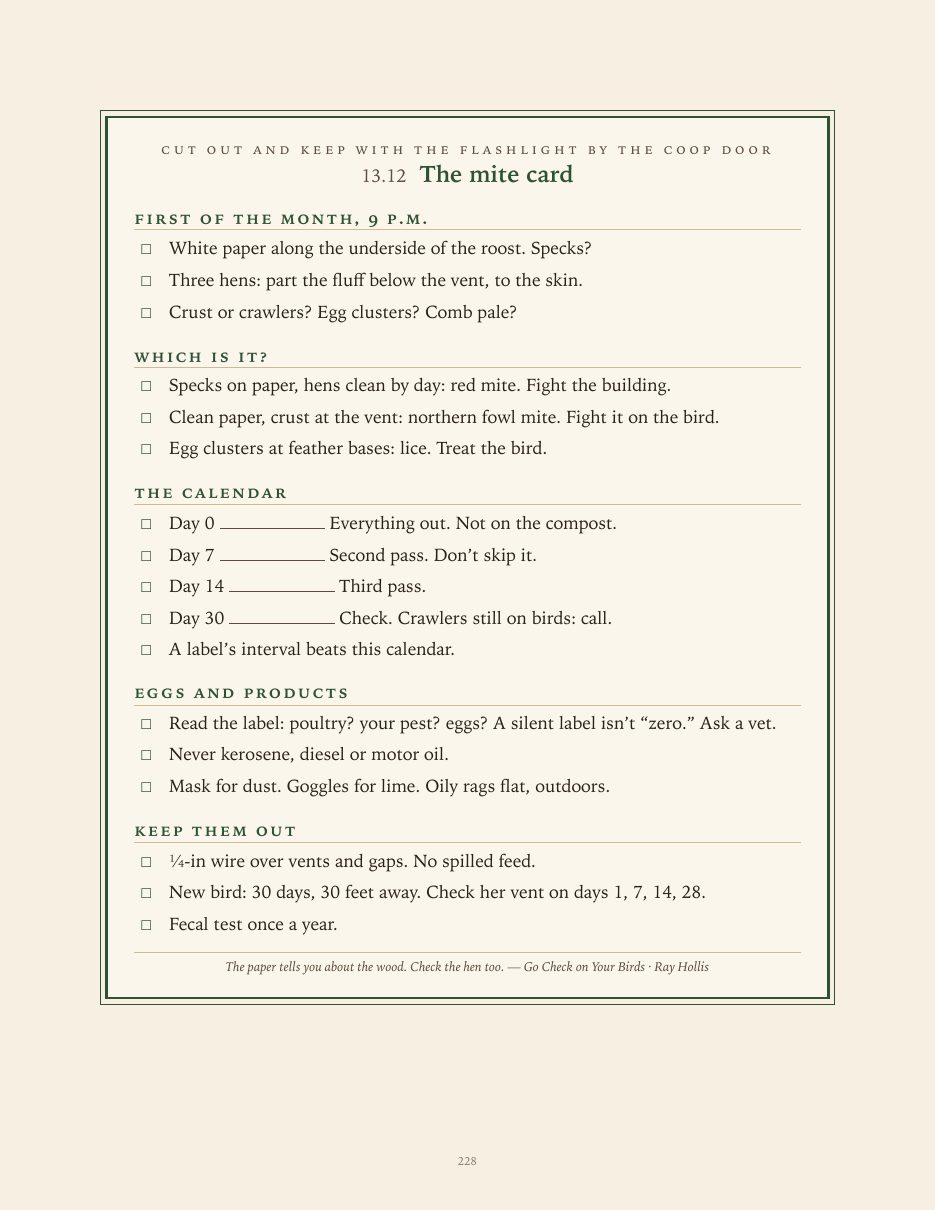
A method tells you what you need, how it’s done, the tonight check, and what to do when it goes wrong. Where a thing has a size, a layout or a calendar, there’s a drawing of it, worked to the same numbers as the text: roost heights, litter depths, the mite cycle, the 21-day hatch. Every chapter ends on a one-page card to cut out and tack up inside the coop door.

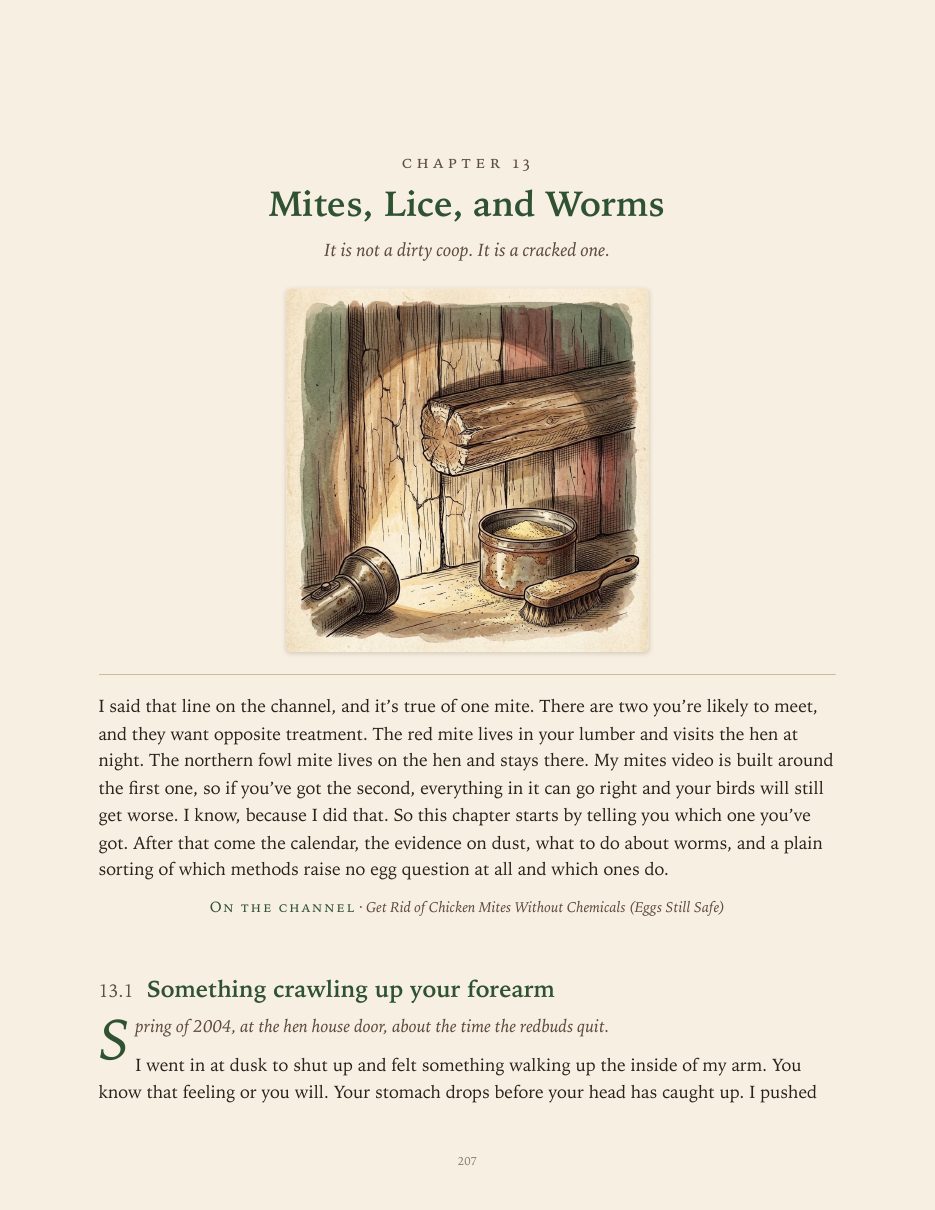
Opening page of Chapter 13, Mites, Lice, and Worms
A chapter opening
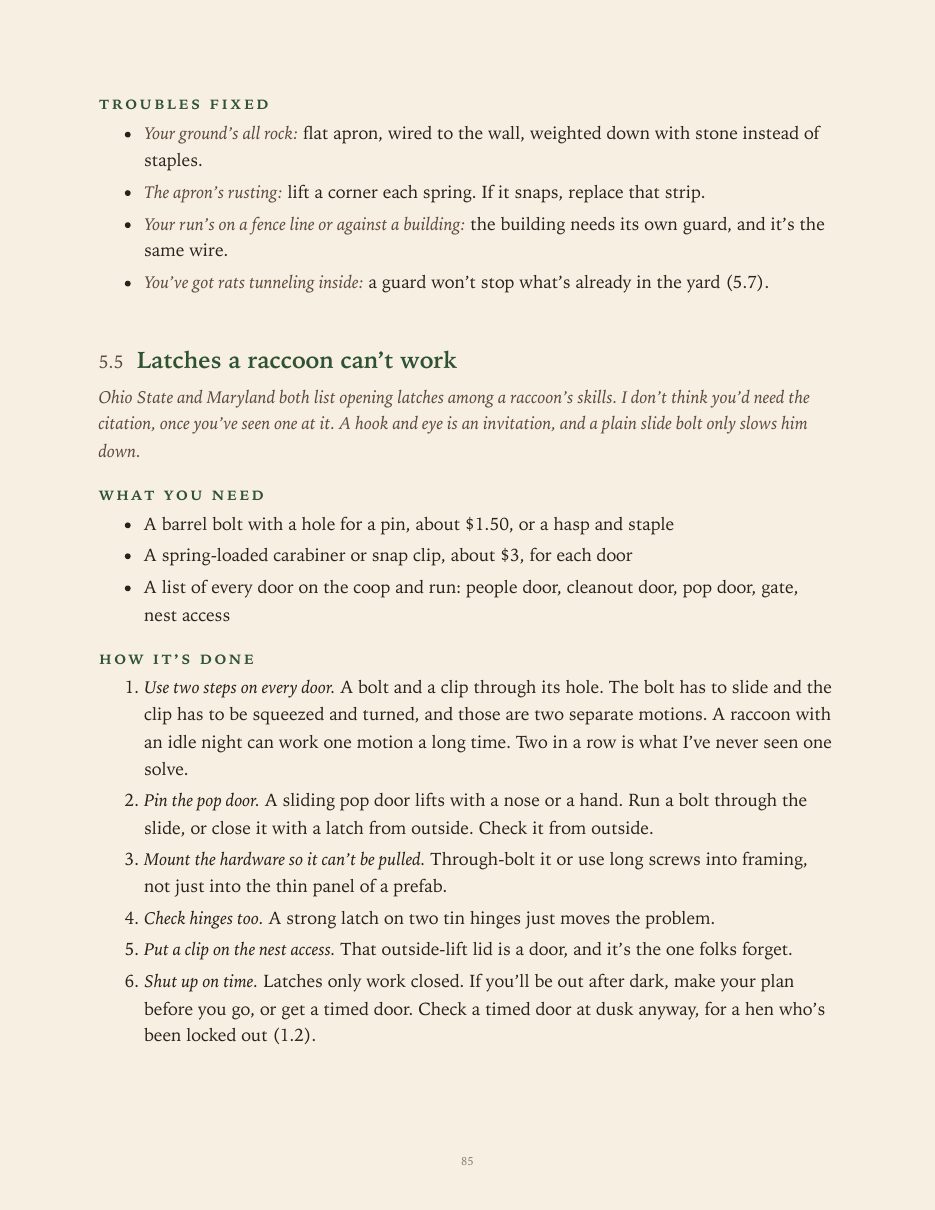
Section 5.5, Latches a raccoon can’t work, with its tonight check
A method, step by step
Section 3.5, roost rails drawn to scale, with the tonight check
A drawing, to scale
The mite card, a one-page checklist
A card for the coop door
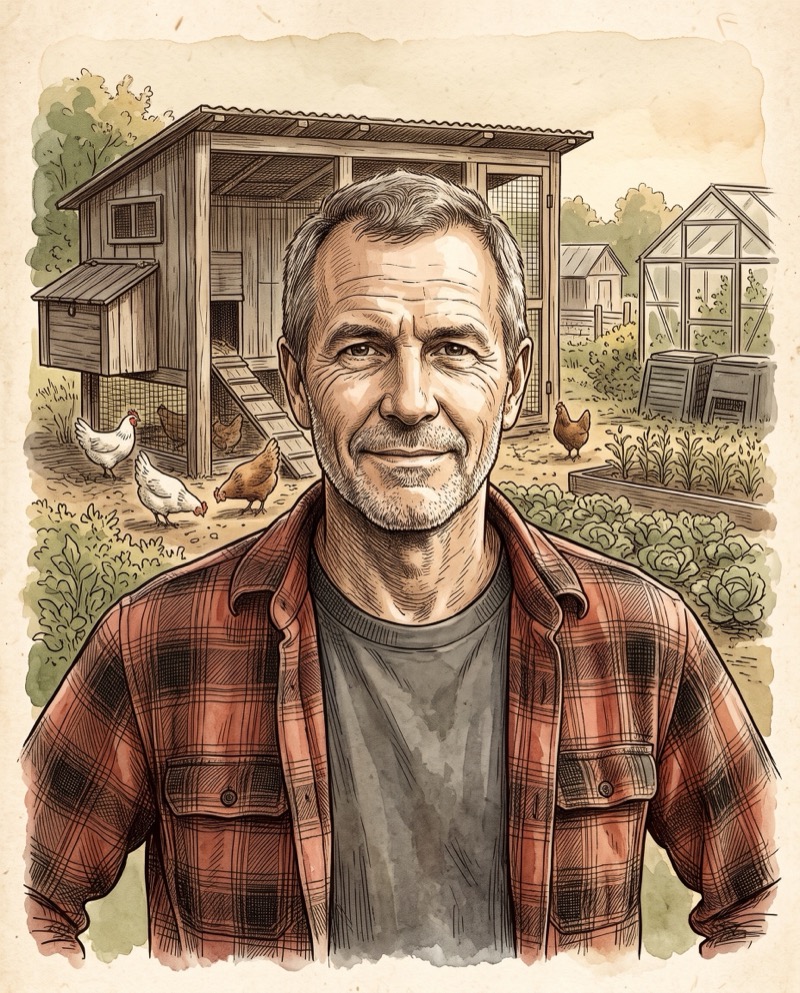
Ray Hollis

About Ray

Forty-one years of hens, on one acre in the Missouri Ozarks.

I kept hens for eleven years before I added up a whole one. I’d been telling people my eggs were free. June found the receipts in a coffee can and did the sum at the kitchen table without comment, then slid it across to me.

That’s about how this book goes. Where the old way works, I’ll show you how it’s done. Where the old way was wrong, the book says so and gives you the safer way right beside it. Keep what still works. Drop what doesn’t.

Go check on your birds. — Ray

Ray Hollis is a narrated character. His stories are written to show how the methods work and are not reports of real events. The methods are drawn from traditional poultry practice, university extension publications, the Merck Veterinary Manual and current public-health guidance, and the sources are listed in Appendix E. Watch the channel →

Go Check on Your Birds, digital edition

Get the book

$37 once. No subscription. Yours to keep.

20 chapters · 177 numbered sections · 390+ pages · 20 cards
80+ illustrations · 75 diagrams worked to the numbers

  • Go Check on Your Birds. The full almanac as a PDF, illustrated throughout, with the five appendices.
  • The large-print edition. The same book in big, easy type.
  • The 20 cards on their own. Each chapter on one printable page.

Launch price: $20 off until December 31, then $57.

The download page opens right after payment, and Stripe emails your receipt. Lost the files? Get them again with the email you paid with.

30-day refund guarantee. If it isn’t what you hoped, write within 30 days and you get every dollar back.

Secure checkout by Stripe. We never see or store your card.

Before you buy

Questions folks ask first.

Does this replace a vet?

No. Chapter 16 tells you what to look for, how to separate a bird, and who to call. The book gives no drug doses and doesn’t have you doing surgery on the kitchen table. Nobody can diagnose your hen from a book.

Is Ray a real person?

No. Ray Hollis is a narrated character, and his stories are written to show how the methods work. They aren’t reports of real events. The methods themselves come from traditional poultry practice, university extension publications, the Merck Veterinary Manual and current public-health guidance, listed in Appendix E. The book hasn’t had a formal veterinary review, so check anything that matters against those sources and your own vet.

I don’t have chickens yet. Is it too soon?

No, that’s a good time to read it. It runs the way a flock gets built: how many birds you need, breeds, where to buy, your local rules, the coop and the run. Chapter 2 prices a start at $150, $500 and $1,500.

I’ve kept hens for years. Is there anything in it for me?

Likely the Trouble Finder, the mite cycle, the feed sums and the ledger. Read the free chapter and the Finder first, and you’ll have a fair idea.

Will my flock pay for itself?

The book doesn’t promise that. On its worked example, a twelve-hen flock costs about $4.48 a dozen before you count your time. Selling surplus eggs and cutting feed waste help, and Chapters 8, 9 and 19 show you how to run the numbers for your own flock.

Have the coop plans been built?

Not as drawn. The two plans in Appendix D were worked out on paper, and the book says so on its first line. Lay it out, check your own cuts, and only then spend money. Ask your zoning office first, too.

Will the rules apply where I live?

The book doesn’t know your county. Rules on keeping birds, selling eggs and processing meat change at the county line, so it tells you where the law matters and to go and check. Prices are typical U.S. retail for 2026 and will differ too.

What exactly do I get, and in what form?

Three PDF files: the full book (letter size), a large-print edition, and the 20 cards on their own. It’s a digital edition, so nothing gets mailed. They open on any phone, tablet or computer, and print on ordinary paper at home or at a copy shop.

I’m not much for computers. Is it hard to get?

After you pay, the next page has three buttons. Tap one and the book downloads. Stripe also emails you a receipt. If you ever lose the files, go to the download page, type the email you paid with, and they’re yours again.

What if it’s not for me?

Write within 30 days of buying by replying to your Stripe receipt, and you’ll get a full refund.
❦

Not ready for the whole book? Take Chapter 1 free.

The Dusk Walk in full, the whole Trouble Finder, and the walk card to tack up inside the coop door. It takes about two minutes at dusk to start.

We’ll write only when there’s something new. Reply to any note and we’ll take you off the list.